How a Working Tool Became a Modern Pet Industry Illusion
The modern dog harness is sold as one of the great symbols of responsible dog ownership. It is marketed as softer, kinder, safer, more comfortable, and more modern than older forms of handling equipment. Across pet shops, online stores, social media advertisements, and dog training advice, the harness is now presented as the natural choice for puppies, strong dogs, reactive dogs, and dogs that pull.
But history tells a very different story.
The dog harness was not originally developed to stop dogs pulling.
It was developed so dogs could pull better.
That single fact changes the entire conversation.
For centuries across Europe and beyond, dogs were not simply companions lying at the fire or walking politely beside their owners. They were working animals. They pulled carts, carried supplies, hauled produce, moved milk, delivered goods, supported farms, assisted soldiers, and helped ordinary working people survive in economies where horses, donkeys, and mules were often beyond reach.
The harness was not a lifestyle product.
It was labour equipment.
And the modern pet industry has largely rewritten that history.
The Working Dog History Often Left Out
When people think of historical transport, they usually picture horses, donkeys, carts, farms, markets, and wealthy landowners. That image dominates paintings, museums, schoolbooks, and public memory.
But it is incomplete.
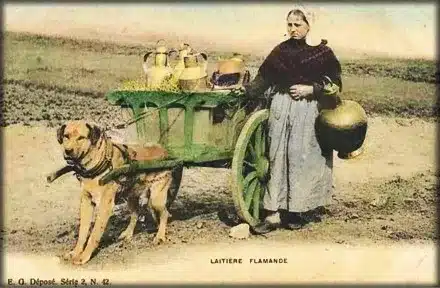
Across Belgium, the Netherlands, France, Germany, and parts of Britain, dog-drawn carts were once a normal part of working life. Dogs pulled milk carts, bread carts, laundry carts, fish carts, vegetable carts, tool carts, and small delivery wagons through streets, farms, villages, canals, and market routes.
These were not rare novelty scenes.
They were part of everyday life for many ordinary people.
In Belgium and the Netherlands especially, dog carts became strongly associated with working-class transport. Milk sellers, small traders, butchers, farmers, and local delivery workers used dogs because they were cheaper to keep, easier to house, and more accessible than horses or donkeys.
The dog became the poor person’s draught animal.
That is the history often missing from the polished version of the past.
The wealthy had horses.
The common worker often had dogs.
And those dogs worked in harness.
The harness was built around function.
The original purpose of a dog harness was practical. It spread load across the dog’s chest and body so the animal could pull weight more efficiently while avoiding direct pressure on the throat.
That design principle was used in cart dogs, sled dogs, freight dogs, military dogs, and later in sporting and working disciplines where pulling remained part of the task.
This is why the modern claim that a harness naturally teaches a dog not to pull is historically absurd.
The harness was designed around traction.
It allowed a dog to place power through the chest and shoulders. It gave the dog comfort while pulling. It made pulling more sustainable, not less.
That does not mean harnesses are bad.
It means they must be understood honestly.
A harness can improve safety in certain contexts. It can protect the neck, help manage dogs in transport, support tracking work, assist rehabilitation cases, and serve clear working or sporting purposes.
But it does not teach engagement.
It does not create direction.
It does not build neutrality.
And it does not replace training.
When a puppy is put into a comfortable harness and allowed to drag forward from the first walks, the lesson is obvious. The dog learns that forward pressure works. The chest goes into the equipment, the body leans into movement, and pulling becomes part of the experience.
The equipment has not failed.
It has done exactly what it was historically designed to allow.
Dog Carts, Europe, and the Law
The history of dog carts also shows that the practice was never free from controversy. By the nineteenth century, concerns about overwork, cruelty, public nuisance, and animal welfare began to grow.
Britain moved early. London restricted the use of dogs for drawing carts in 1839 through the Metropolitan Police Act, and wider restrictions followed in England in the mid-nineteenth century. These laws were not introduced because dog carting was imaginary or rare. They were introduced because the practice existed visibly enough to attract legal and welfare concern.
In continental Europe, the practice continued longer.
Belgium and the Netherlands became particularly associated with dog-drawn carts, especially for milk and market transport. Historical photographs from Antwerp, Brussels, Dutch towns, and rural routes show teams of working dogs harnessed to carts carrying goods through daily life.
These images matter because they correct the romantic version of history.
Working dogs were not always glamorous.
They were part of survival economies.
They carried what people could not carry themselves.
War Made the Harness Operational
The role of harnessed dogs did not end at civilian labour. During World War I, and again in different forms during World War II, dogs were used in military service across Europe.
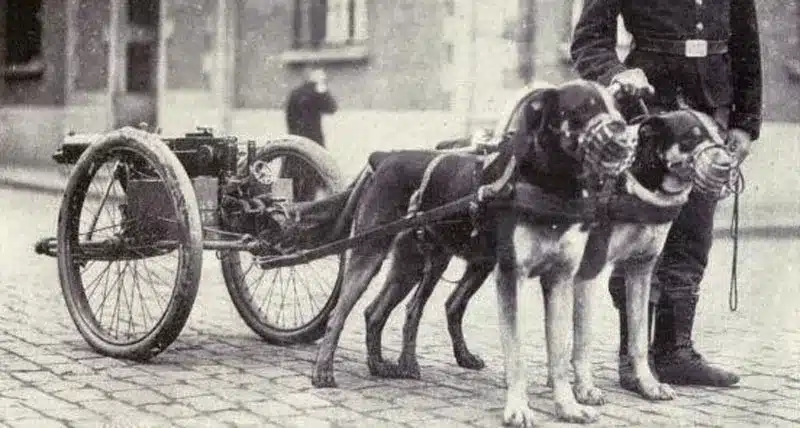
They hauled machine-gun carts, ammunition carts, supply carts, and equipment. They carried medical supplies, water, and messages. Red Cross and ambulance dogs were sent into dangerous areas to locate wounded soldiers, often carrying supplies in harness or saddlebag arrangements.
In difficult terrain, mud, snow, trenches, and bomb-damaged ground, dogs could move where larger animals and vehicles struggled.
The Belgian army famously used dogs to pull machine guns and supplies during the First World War. Other European forces also relied on dogs for transport, communication, rescue, and logistical support.
These dogs were not pets dressed for comfort.
They were operational working animals.
Their harnesses were part of their job.
The harness existed to help the dog pull, carry, transport, and function under extreme conditions. It was linked to endurance, strength, discipline, and purpose.
That history is almost completely absent from the way harnesses are sold today.
Modern Pet Culture Rewrites the Equipment.
The modern pet industry has taken the harness and detached it from its origin.
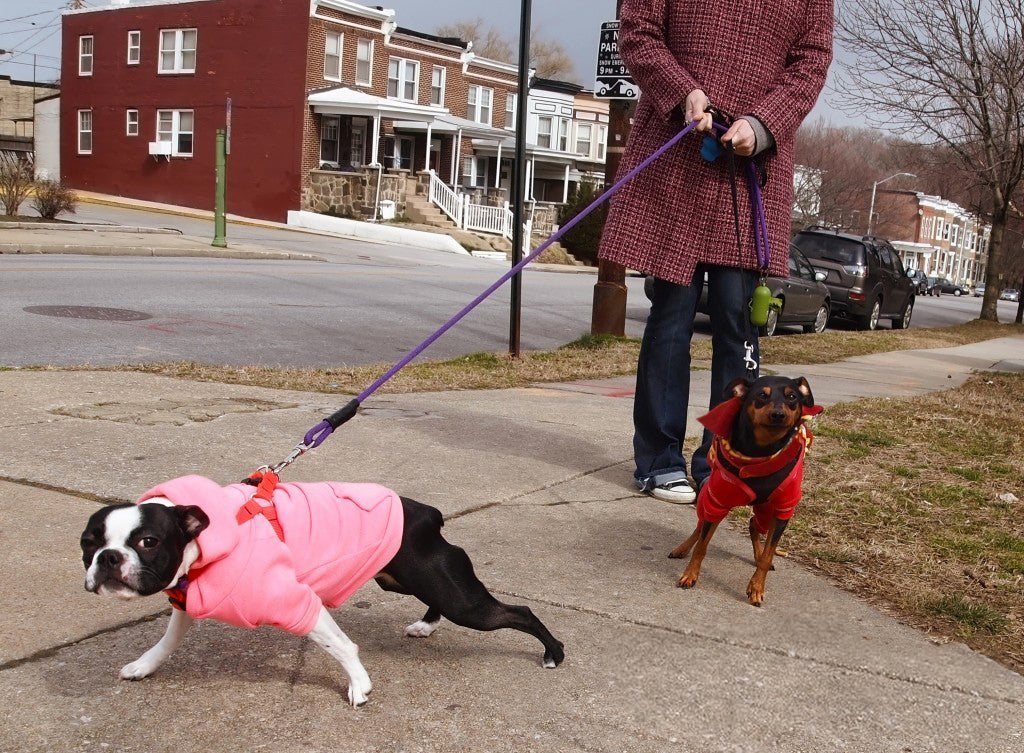
Today, harnesses are sold through softness, colour, fashion, branding, safety language, and emotional reassurance. Pet owners are told that the right harness will make walks calmer, kinder, easier, and more controlled.
In some cases, a well-fitted harness is absolutely appropriate.
But the marketing often goes further than the equipment can honestly deliver.
A harness cannot solve pulling on its own. It cannot replace owner engagement. It cannot correct poor early walking habits. It cannot stop a dog becoming overexcited, frustrated, reactive, or disconnected from the handler.
And in many homes, the harness becomes part of the problem because it allows the dog to rehearse exactly the behaviour the owner later wants to stop.
Pull forward.
Feel comfortable.
Gain ground.
Repeat.
That is not loose-lead walking.
That is pulling made easier.
The Puppy Problem
This issue becomes especially important with puppies and young dogs.
Many puppies leave the home for their early walks already fitted with a harness. From the first day outside, they are allowed to surge forward, hit the end of the lead, lean into the equipment, and drag towards scents, people, dogs, movement, and stimulation.
The owner believes the puppy is simply excited.
But the puppy is learning.
It is learning that forward force creates movement. It is learning that pulling gives access. It is learning that the person at the other end of the lead is not something to engage with, but something to pull against.
Over time, that becomes habit.
Then the dog grows.
The body becomes stronger. The excitement becomes more intense. The lack of direction becomes more obvious. What began as puppy enthusiasm becomes pulling, frustration, scanning, lunging, vocalising, and in some cases, leash reactivity.
At that stage, the behaviour is no longer beginning.
It is established.
The harness did not create the dog’s drive.
But it often helped the dog rehearse the wrong use of that drive.
Harnesses, Reactivity, and False Control
Modern dog owners are often told to use harnesses for control. Yet control is not the same as connection.
A harness can restrain a dog physically, but it cannot create understanding. It can reduce pressure on the neck, but it does not automatically reduce emotional arousal. It can make handling safer in some contexts, but it can also give strong dogs greater mechanical comfort while pulling.
This is where many owners become trapped.
The dog feels physically manageable enough to continue walking, but behaviour continues to escalate underneath. The dog is still scanning. Still pulling. Still loading. Still building frustration. Still rehearsing intensity.
The harness allows the walk to continue.
But the behaviour is not being resolved.
In some dogs, especially powerful young dogs, the harness gives enough comfort and leverage for the dog to drive harder into the environment. If the fit is poor, some dogs can also slip out, especially when backing away, twisting, panicking, or reacting.
Again, the issue is not that every harness is wrong.
The issue is believing the harness is the solution.
It is not.
It is only equipment.
Where Harnesses Still Belong
A serious editorial must be honest on both sides.
Harnesses absolutely have a place.
They are valuable in sled work, carting, canicross, tracking, mantrailing, search work, vehicle safety, assistance work, veterinary rehabilitation, and controlled working disciplines where the equipment has a clear purpose.
In those environments, the harness is not pretending to be something else.
It is being used as equipment for a task.
That is very different from placing a harness on an untrained young dog, allowing it to pull through every walk, and expecting the dog to somehow develop calm lead behaviour by accident.
The problem is not the harness itself.
The problem is the modern misunderstanding of what the harness is, what it was designed to do, and what it cannot replace.
The Bigger Failure in Modern Dog Advice
The harness has become a symbol of a wider issue within modern dog culture.
Owners are increasingly sold equipment before understanding. They are sold products before structure. They are sold comfort before clarity.
Pet stores and online brands offer harnesses in every colour, shape, design, and promise. Anti-pull harnesses, escape-proof harnesses, comfort harnesses, adventure harnesses, puppy harnesses, tactical harnesses, soft harnesses, padded harnesses — the market is endless.
But none of these products replace the one thing dogs actually need.
Direction.
A dog that has no engagement with the owner, no structure on the walk, no understanding of boundaries, and no clear outcome for pulling will not be fixed by a different piece of fabric.
The dog will simply continue learning through what works.
And if pulling works, pulling remains.
The Forgotten Truth
The history of the dog harness is not a small detail.
It exposes a major contradiction in modern dog ownership.
For centuries, harnesses were used because dogs were expected to pull. They pulled carts through Europe, hauled supplies in war, carried goods for working people, supported farms, moved produce, and helped ordinary families survive.
The harness belonged to that world.
A world of work.
A world of purpose.
A world where dogs were physically and mentally engaged in tasks that made sense.
Modern pet culture inherited the harness from that world, then repackaged it as a soft solution to problems it was never designed to solve.
That is the part owners need to understand.
A harness can be useful.
But it is not training.
It is not engagement.
It is not direction.
And it is not a substitute for understanding the dog at the end of the lead.
The modern pet world did not invent the harness.
It inherited a working tool.
And then forgot what it was for.
Philip Alain
The Canine Report