Why One of History’s Most Capable Working Dogs Fell Out of Favour in Modern Dog Culture
Long before modern military working dogs were trained for highly specialised tasks such as bomb detection, tactical apprehension, and controlled search operations, war dogs were expected to perform at a level that demanded far more than obedience alone.
They were expected to think independently.
And few breeds represented that reality more clearly than the Airedale Terrier.
Often referred to historically as the “King of Terriers”, the Airedale earned global recognition during the First and Second World Wars for its ability to perform under conditions that would overwhelm most dogs. These were not dogs working in tightly managed environments under constant handler direction. They were frequently required to operate alone, navigate battlefield conditions independently, and complete tasks without immediate human guidance.
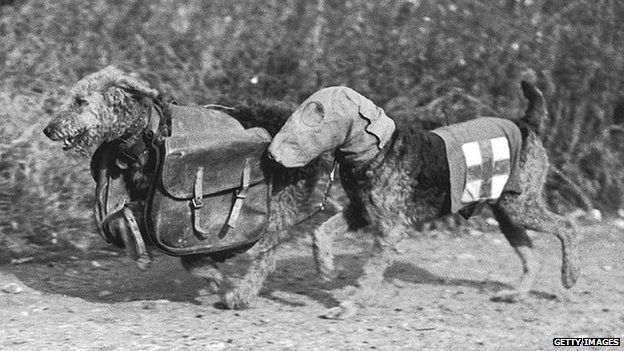
Historical military records and wartime accounts consistently reference the Airedale’s use as a messenger dog, patrol dog, guard dog, medic supply dog, and reconnaissance dog. They moved across active battlefields carrying communication messages between units, often travelling long distances through artillery fire and collapsing terrain. Some were tasked with locating wounded soldiers and carrying emergency medical supplies directly to the front lines. Others transported ammunition and equipment through areas where visibility, noise, and chaos would have caused many animals to shut down entirely.
These dogs were also expected to work while wearing gas masks during chemical warfare periods — something that dramatically reduced visibility and interfered with scenting ability. Yet the breed continued to perform.
That level of function required more than trainability.
It required nerve, environmental awareness, problem-solving ability, and the confidence to make decisions without waiting for instruction.
And that is precisely where the modern world began to move away from them.
The Difference Between Historical War Dogs and Modern Military Dogs
Modern military and police dogs are highly specialised. The majority work in close coordination with handlers, operating within structured systems built around precision control and direct communication. Their roles are narrower, more task-specific, and designed around immediate handler response.
The modern system values control.
Historically, the Airedale Terrier represented something different.
The breed was valued because it could function independently when communication failed, when handlers were absent, or when battlefield conditions became unpredictable. The dog was expected to assess terrain, navigate danger, and complete the objective regardless of circumstance.
That type of independence is far less desirable within modern systems that prioritise exact compliance and constant handler oversight.
In many ways, the traits that once made the Airedale exceptional are the same traits that reduced its popularity in the modern working world.
An Independent Thinker in a World Built Around Control
The Airedale Terrier was never designed to be a robotic follower.
The breed developed as a versatile working dog capable of hunting, guarding, tracking, dispatching vermin, protecting property, and adapting rapidly to changing environments. Unlike breeds bred heavily for repetitive handler-directed obedience, the Airedale retained a strong ability to assess situations independently.
That distinction matters.
Modern dog culture increasingly rewards instant compliance, constant direction, and highly managed behaviour. Dogs are expected to respond immediately, remain environmentally neutral, and function within tightly controlled routines.
The Airedale often approaches situations differently.
Owners and working handlers frequently describe the breed as calculating, observant, and capable of developing its own path toward completing a task. Rather than responding mechanically, the dog evaluates the environment and acts according to what it determines is effective.
This is not a lack of intelligence.
It is a different expression of intelligence.
And historically, it was exactly what made the breed valuable.
The Behavioural Traits That Never Disappeared
Despite changes in modern working dog selection, many of the original behavioural traits associated with the Airedale Terrier remain visible today, particularly within stronger working lines.
Handlers continue to report examples of problem-solving behaviour that appear difficult to explain purely through direct training. Dogs adjusting river crossings based on current strength, using terrain strategically during hunting work, coordinating movement within groups, or prioritising environmental threats over distractions are all behaviours repeatedly described by experienced working owners.
These traits reflect something deeper than simple obedience.
They reflect environmental processing and independent behavioural adaptation.
In practical terms, the Airedale often behaves less like a dog waiting for instruction and more like a dog attempting to complete an objective.
That distinction can create frustration in modern pet ownership environments where predictability and immediate compliance are heavily prioritised. But historically, those exact qualities were considered essential.
Why the Breed Still Fascinates Working Dog Enthusiasts
The Airedale Terrier occupies a unique position within the canine world. It sits between the old and the modern — between the independently functioning war dog of the early twentieth century and the highly controlled working dogs favoured today.
For many enthusiasts, that is precisely what makes the breed so compelling.
The Airedale represents a period when dogs were expected not only to follow instruction, but to function intelligently under pressure, adapt without guidance, and continue working within environments where structure had collapsed entirely.
That type of dog requires trust.
Not simply trust in training, but trust in the dog’s own ability to process, decide, and act effectively within the situation presented.
And in a modern world increasingly built around control, that level of independence has become increasingly rare.
Conclusion
The Airedale Terrier did not disappear from modern relevance because it lacked capability.
In many ways, it became too independent for the systems that replaced the world it once operated within.
The same intelligence, resilience, adaptability, and environmental awareness that allowed the breed to succeed in war are the same traits that make it more challenging within a culture that increasingly values precision control over independent function.
Yet those qualities remain part of what makes the breed extraordinary.
Because long before modern military dogs became highly specialised tools, the Airedale Terrier represented something broader — a dog capable of thinking, adapting, and functioning within chaos itself.
And history still remembers that.
Philip Alain
The Canine Report