
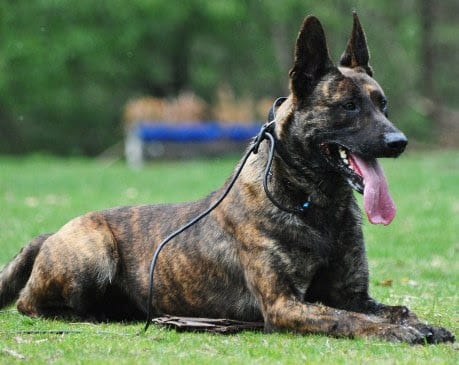
For more than a century, the Royal Dutch Police Dog Association has operated as one of Europe’s most influential yet widely misunderstood working-dog institutions. Established in the Netherlands in 1907 and granted royal recognition in 1912, the Koninklijke Nederlandse Politiehond Vereniging was never designed as a breed club, a sporting organisation, or a commercial training pathway. Its sole purpose was, and remains, the objective evaluation of dogs for real operational work.
At a time when policing demands were increasing and dog training standards varied widely between regions, the founders identified a fundamental problem: there was no consistent way to define what made a dog genuinely reliable under pressure. Their solution was not theory, appearance, or pedigree—but performance. From its inception, the KNPV system has been grounded in one uncompromising principle: a working dog must prove itself through function.
Origins Rooted in Practical Policing
The KNPV was founded by experienced Dutch police dog handlers already working dogs in real policing environments. These were practitioners dealing with patrol work, tracking, public order, and suspect apprehension. Early records identify figures such as A.J. Steijns, Couwenberg, Van Oosten, and Lokerse, each working different dogs of varying types.
What unified these early dogs was not paperwork, but shared traits:
courage under pressure
willingness to engage conflict when required
environmental stability
trainability and handler focus
reliability in unpredictable, real-world situations
The KNPV did not attempt to create a new breed. It created a shared standard for evaluating working ability—and that standard remains intact.
What KNPV Is — and What It Is Not
KNPV is not a breed registry.
It does not exist to preserve conformation standards or promote aesthetic traits.
It is a certification and testing system designed to assess dogs against demanding, operational criteria, including:
tracking and scent discrimination
obedience under distraction
agility and environmental confidence
controlled aggression and grip work
object guarding and endurance
Dogs that pass KNPV trials demonstrate clarity under stress, strong nerves, physical durability, and recovery after pressure. These qualities—not pedigree titles—define a KNPV-tested dog.
The Dogs Most Commonly Associated With KNPV
Over time, certain types of dogs repeatedly proved capable of meeting KNPV standards. As a result, the system became closely associated with:
Belgian Malinois
Dutch Shepherds
working shepherd-type crosses selected for function
This association developed organically. It reflects repeated performance outcomes rather than ideological preference. Dogs that could not sustain pressure, intensity, and learning demands were naturally excluded.
It is critical to be precise here: KNPV dogs represent selected working populations, not a separate breed.
The Dutch Shepherd and the Working Gene Pool
The Dutch Shepherd has deep roots in the Netherlands as a functional farm and utility dog. Early police competitions already featured shepherd-type dogs valued for resilience, stamina, and adaptability. However, the KNPV working population diverged early from modern show-bred Dutch Shepherds.
Following population losses during the World Wars, working breeders prioritised functional recovery rather than genetic purity. Strategic outcrossing—most notably with Belgian Malinois—was used to preserve drive, nerve, and athleticism. As a result, many dogs described today as “KNPV Dutch Shepherds” do not align neatly with modern kennel-club definitions. Within KNPV breeding, phenotype has always been secondary to operational capability.
The Rise of the Belgian Malinois
As KNPV trials evolved and demands increased, the Belgian Malinois became increasingly prominent. Its intelligence, drive, speed, and resilience proved exceptionally well-suited to the system’s requirements. Malinois influence became deeply embedded within KNPV working lines—not as a fashion choice, but as a functional response to testing outcomes.
Many historically successful KNPV dogs held no traditional kennel-club registration, yet demonstrated higher functional reliability than registry-focused counterparts.
Documented Working Dogs and Influential Bloodlines
KNPV culture does not elevate dogs through marketing or mythology. Influence is measured by repeatable performance, working progeny, and operational suitability. Nevertheless, certain dogs and lines are consistently referenced in public working-line documentation, stud records, and professional discussion across decades.
Historically referenced dogs include:
Fritz – a Dutch Shepherd-type dog documented in early European police working contexts, illustrating the system’s foundations
Nico van Neerland – recorded as a highly capable KNPV-titled working dog
Rudie – frequently referenced in connection with Nico van Neerland
Kazan Beck – documented in national-level KNPV championship contexts
Caro van Brandevoort – recorded as holding multiple KNPV working titles, including object guarding
Influential working-line stud names commonly cited in KNPV-related pedigrees and professional records include Rico Vergossen, Duco II (Seegers), Django Doelen, Wibo van Leeuwen, Rambo Rossum, Pecco Pegge, Arras Pegge, Quatro Peulken, Tommy Luijken, and Catro.
These names are included not as legends or promotional icons, but as documented reference points within a performance-driven system where influence is proven through results and progeny.
What a BRN Is — and Why It Exists
Within the Dutch working-dog system, dogs evaluated under KNPV standards are recorded in a central database. Each registered dog is assigned an individual BRN (Basis Registratie Nummer).
A BRN exists to:
uniquely identify a dog within the working-dog registry
link test results, certifications, and trial history to that individual
allow traceability of working performance across generations
support transparency and accountability within the system
A BRN is not a quality score, ranking, or mark of prestige. It is an administrative identifier used to document performance history. Many historically influential dogs predate consistent BRN usage or are known primarily through working records rather than modern databases—hence why professional discussion references dogs by name and context rather than registration numbers.
Influence Beyond the Netherlands
Although Dutch by origin, the KNPV’s influence is international. Dogs trained or bred under KNPV principles are found in police, military, and security roles worldwide. In the UK and Ireland, small but serious communities of trainers and handlers continue to study and apply KNPV methodology, often operating quietly outside mainstream pet-dog culture.
Many possess experience and technical ability comparable to professional police or military canine units, despite remaining largely unknown to the general public.
A Counterpoint to Modern Dog Culture
The KNPV stands in contrast to modern trends where dogs are frequently selected for appearance, market demand, or social visibility. Its legacy reinforces a reality often overlooked:
Genetics matter. Selection matters. Function cannot be trained into a dog that lacks the foundation to support it.
The KNPV did not create a breed, a trend, or an ideology. It created a framework for identifying and preserving working ability—one that continues to shape serious working dogs more than a century later.
The Canine Report
By Phillip Alain