
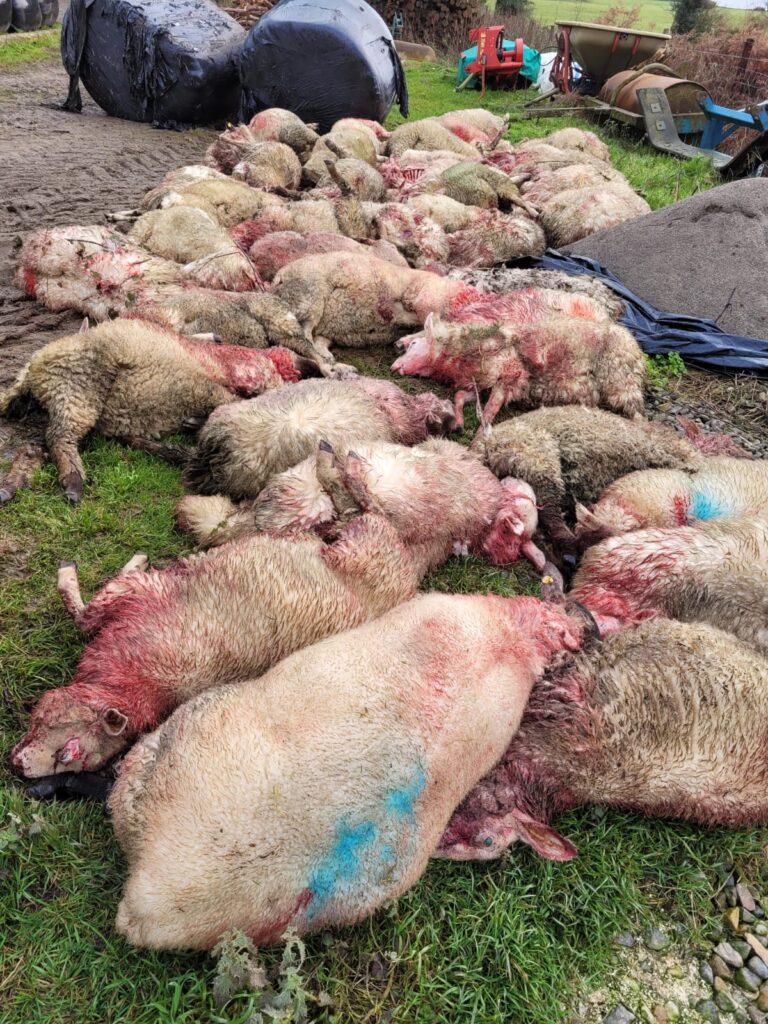
A serious livestock worrying incident in Cheshire, England, in which a dog killed 23 sheep on a working farm, has once again drawn attention to a problem that repeats itself every year across Ireland, the UK, and mainland Europe.
The incident occurred on a rural farm near Macclesfield, where a dog entered a field containing sheep and carried out a sustained attack. By the time the incident concluded, 23 animals were dead, either from direct injuries or as a result of subsequent euthanasia due to the severity of trauma sustained.
Police attended the scene following reports from the landowner. While media headlines focused on the presence of armed officers, authorities later confirmed that no firearms were discharged and that the police response was precautionary in nature. The core issue, however, remains unchanged: livestock were killed, and a working farm suffered significant loss.
Not an Isolated Incident
This was not an unusual or rare event.
Every year, thousands of sheep and farm animals are injured or killed across Ireland, the UK, France, Germany, and other European countries as a result of uncontrolled or roaming dogs. These incidents occur most frequently during:
lambing season
spring and summer walking months
holiday periods when dogs are exercised in unfamiliar rural areas
In Ireland alone, farming organisations regularly report hundreds of livestock worrying incidents annually, with financial losses running into millions of euro. Beyond economic damage, the welfare impact is severe — sheep can die from stress-induced shock even without visible bite wounds.
A Preventable Welfare Issue
In the vast majority of cases, these incidents are not caused by so-called “dangerous dogs”, but by pet dogs:
allowed off lead near livestock
inadequately recalled
escaped from homes or vehicles
assumed by owners to be “friendly” or “would never harm anything”
Sheep are prey animals. A dog does not need to be aggressive to cause catastrophic harm — chasing alone can kill. Once a dog enters a flock and triggers panic, the outcome can escalate rapidly and uncontrollably.
This is not a failure of the dog.
It is a failure of management, awareness, and responsibility.
Ireland: The Same Pattern, Every Year
Ireland mirrors this pattern closely.
Irish farmers repeatedly report dogs:
entering fields from public walking routes
being exercised off-lead in rural areas
escaping from gardens in countryside locations
Under Irish law, sheep worrying is a criminal offence, and farmers are legally entitled to protect livestock, including taking lethal action where necessary. Despite this, many incidents go unreported, and prosecutions remain relatively rare compared to the scale of the problem.
The result is ongoing tension between dog owners and rural communities — tension that is entirely avoidable.
The Human Cost on Farmers
Livestock attacks are not abstract events. They involve:
animals dying violently
farmers discovering injured or dead stock
long-term stress on remaining animals
financial loss and emotional toll
For many farmers, sheep are not replaceable units; they are the product of years of breeding, care, and labour. An attack can undo a season’s work in minutes.
Education, Not Sensationalism
These incidents should not be used to demonise dogs — but they must be used to educate owners.
Responsible dog ownership in rural and semi-rural environments means:
dogs on leads near livestock, always
secure fencing and gates at home
understanding that instinct overrides training in prey situations
recognising that “normally good dogs” can still kill livestock
This is not about fear.
It is about reality, responsibility, and prevention.
A Recurring European Issue That Requires Accountability
From Ireland to the UK and across Europe, the same tragedy repeats year after year. The solution is not harsher rhetoric, but consistent education, enforcement, and owner accountability.
Every livestock attack caused by a roaming dog is avoidable.
Every one represents a breakdown in human responsibility — not canine intent.
Philip Alain
The Canine Report