
Force-free training has become the defining standard of the modern dog training industry. It has reshaped how dogs are handled, moving the conversation away from poorly applied punishment and towards reinforcement, engagement, and welfare. That shift has been necessary, and in many cases, long overdue.
But as the industry has moved in one direction, something equally important has been pushed aside.
The reality of how dogs actually learn.
Where Force-Free Holds Its Strength
There is no question that reinforcement-based training forms a critical foundation. When applied correctly, it produces engaged dogs, clear communication, and a positive working relationship between dog and handler. In controlled environments, where timing is precise and behaviour is managed closely, the results can be highly effective.
Dogs learn what works.
They repeat behaviours that produce reward.
This is a fundamental part of learning theory, and it is not in dispute.
Where It Begins to Break Down
The difficulty is not in the method itself, but in how completely it is expected to account for real life.
Outside structured environments, control drops. Timing becomes inconsistent. Environments change without warning. Dogs are exposed to movement, pressure, unpredictability, and competing motivations that cannot be managed in the same controlled way.
In those moments, behaviour is not shaped by intention.
It is shaped by outcome.
If a dog pulls and reaches what it wants, it learns.
If a dog ignores recall and continues moving, it learns.
If a dog persists and eventually succeeds, it learns.
Dogs do not pause their behaviour while the handler attempts to respond correctly. They are constantly adapting to what produces results in real time.
The Missing Conversation: Pressure and Consequence
What is often absent from modern discussion is the role of pressure and consequence within learning. Not as punishment in the crude sense, but as part of how behaviour is naturally shaped.
Dogs do not grow up in consequence-free environments.
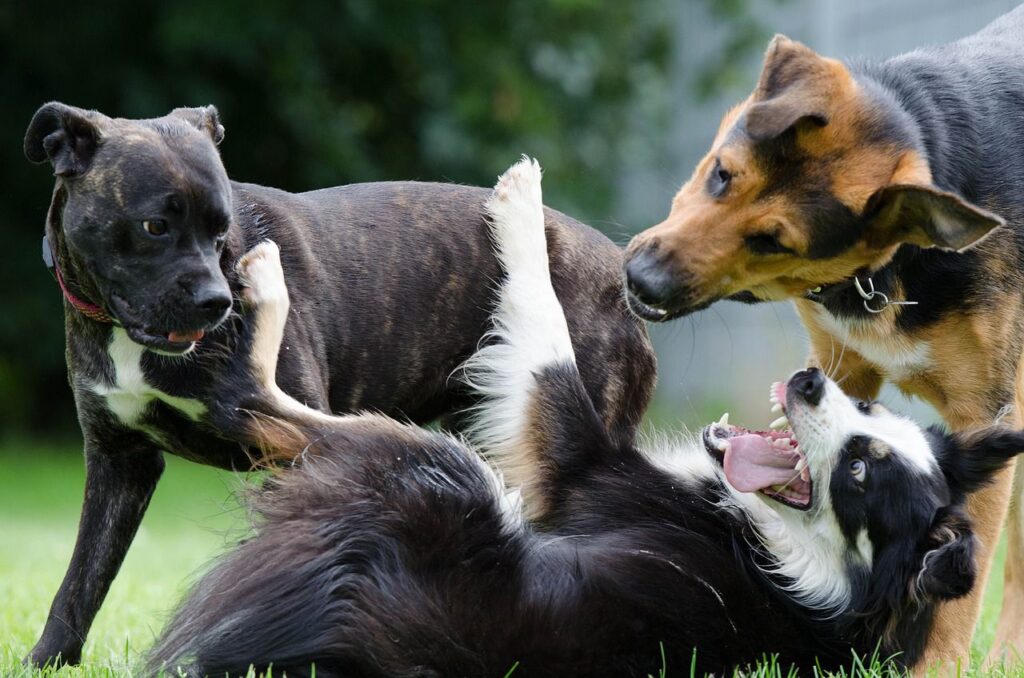
They experience social pressure from other dogs. They are corrected, blocked, displaced, and restricted within normal interaction. They learn through outcomes — what works, what does not, and what carries a cost.
This is not theory.
It is observable behaviour.
Pressure, in this context, is not harm. It is information. It creates decision-making. It forces the dog to adjust, to consider, and to learn from the result of its actions.
Remove that entirely, and the learning picture does not become cleaner.
It becomes incomplete.
Balanced Training: Misunderstood, Not Defined
The term “balanced training” is often reduced to something far simpler than it actually represents. At its core, it is not about introducing harsh correction or abandoning reinforcement. It is about acknowledging that learning involves both reward and consequence.
Reinforcement builds behaviour.
Consequence defines its limits.
When applied correctly, the two do not conflict. They complement each other. The dog is shown what works, but it is also given clarity on what does not. That clarity is what allows behaviour to stabilise under pressure, not just in controlled conditions.
Without it, behaviour remains situational.
Why Ideology Creates Gaps
The problem emerges when one side of learning is removed entirely on ideological grounds. When all forms of pressure or consequence are grouped together and rejected, the system loses its ability to adapt to real-world situations.
Dogs are not learning within controlled environments alone.
They are learning:
- in motion
- under distraction
- under pressure
- in moments where timing is imperfect
In those conditions, behaviour that is not clearly defined does not disappear. It becomes stronger. It becomes more efficient. It becomes harder to change.
The gap is not theoretical.
It shows up in the dog.
What the Research Actually Supports
Behavioural research consistently shows that poorly applied punishment, unpredictable correction, and excessive pressure increase stress and damage trust. That evidence is clear and should guide practice.
But learning theory is equally clear on another point.
Behaviour is shaped by consequence.
This is the principle every training system answers to.
Remove consequence entirely, and learning does not stop.
It simply becomes less precise.
Dogs Learn From What Happens, Not What Is Intended
This is the principle that sits underneath everything.
Dogs do not respond to what we mean to teach. They respond to what actually happens. If behaviour leads to success, it is repeated. If it carries a cost or fails to produce a result, it changes.
This does not shift based on labels such as “force-free” or “balanced”.
It is governed by outcome.
Conclusion
The industry does not need to abandon reinforcement-based training. It needs to stop presenting it as complete in isolation. Because dogs do not live in controlled environments, and they do not learn through reward alone.
They learn through experience.
They learn through pressure.
They learn through consequence.
The objective is not to increase force.
It is to increase clarity.
Because in the end, a dog is not guided by ideology.
It is guided by what works.
And when that becomes clear, behaviour doesn’t just improve —
it becomes predictable.
Philip Alain
The Canine Report