
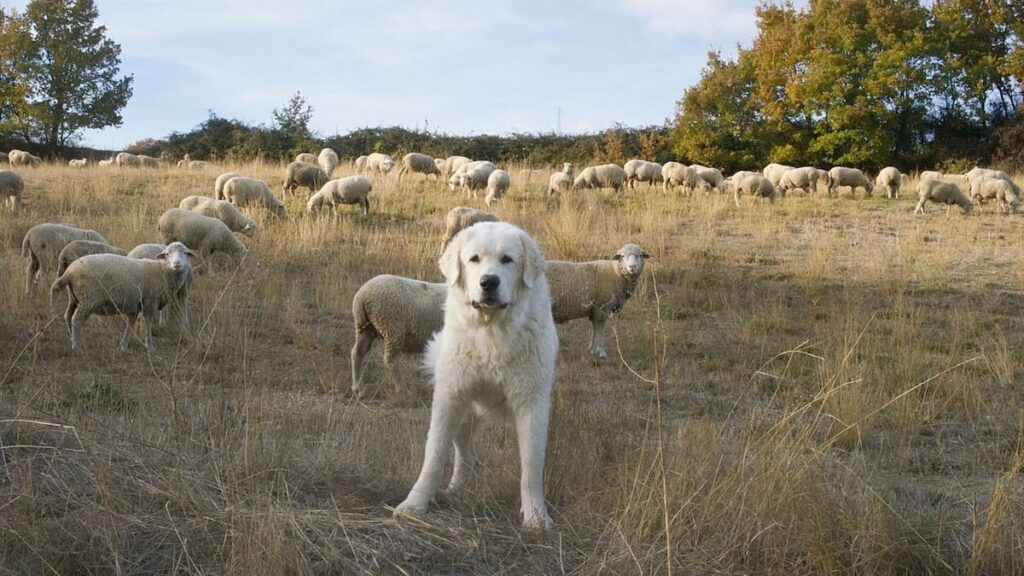
How Ancient Working Dogs Are Protecting Livestock in Modern Europe
As pressure increases on rural communities across Europe, a centuries-old solution is quietly re-emerging at the centre of modern livestock protection: the livestock guardian dog.
From wolf recovery programmes to rising incidents of loose dog attacks on sheep, farmers across Europe are facing challenges that fencing, surveillance, and lethal control have failed to solve sustainably. In response, a growing number of regions are returning to a method that predates modern agriculture itself — living, working guardian dogs integrated directly into the flock.
This is not a new concept. It is a forgotten one.
The Origins of Livestock Guardian Dogs
Livestock guardian dogs are among the oldest functional dog types in the world. Unlike herding dogs, which move livestock, guardian dogs are bred to live with and defend animals such as sheep and goats on a full-time basis.
Archaeological and historical records trace their use back thousands of years across:
The Mediterranean basin
Central and Eastern Europe
The Balkans
Anatolia and the Caucasus
The Iberian Peninsula
Their role was simple and remains unchanged:
deter predators through presence, territory, and confrontation if necessary.
These dogs were never selected for obedience trials, sport, or appearance. They were selected for:
Strong protective instinct
Independence of decision-making
Low prey drive toward livestock
High territorial awareness
Calm, stable temperament under pressure
Guardian Dogs in Europe Today
Across Europe, livestock guardian dogs are now being reintroduced or formally supported in response to:
The return of wolves and large predators
Rising sheep worrying incidents by domestic dogs
Increased public access to rural land
Reduced tolerance for lethal predator control
Countries where guardian dog programmes are actively used or supported include:
Portugal
Spain
Italy
France
Germany
Austria
Switzerland
The Balkans
Parts of Eastern Europe
In many regions, guardian dogs are deployed at ratios such as multiple dogs per several hundred sheep, living with the flock year-round rather than being handled intermittently.
How Guardian Dogs Actually Work
Guardian dogs do not hunt predators. They change predator behaviour.
By living continuously with livestock, they establish what ecologists describe as a “landscape of fear” — an area predators learn to avoid due to consistent territorial resistance.
This deterrence works through:
Scent marking
Vocalisation
Visible presence
Group defence when needed
Importantly, this approach reduces attacks without requiring predators to be killed, making it one of the few genuinely non-lethal, long-term livestock protection strategies available.
Not Herding Dogs. Not Pets.
A critical distinction often misunderstood by the public is that guardian dogs are not herding dogs and not companion animals in the conventional sense.
Common guardian breeds and types include:
Maremma Sheepdogs
Pyrenean Mountain Dogs
Anatolian Shepherds and Kangals
Central Asian and Balkan livestock guardians
Regional landrace guardian types
These dogs are not trained through repetitive commands. Their effectiveness depends on:
Early placement with livestock
Genetic selection for guarding behaviour
Minimal human interference
Clear territorial boundaries
Attempts to raise guardian dogs as house pets and later “convert” them almost always fail. This work depends on genetics, environment, and purpose, not ideology.
Protection From Wolves — and From Dogs
While wolf predation receives the most attention, data across Europe consistently shows that uncontrolled domestic dogs account for a significant proportion of livestock attacks, particularly near populated rural areas.
Guardian dogs act as a deterrent to:
Wild predators
Free-roaming dogs
Loose pets walked off-lead near livestock
This has made guardian dogs increasingly relevant not only for conservation zones, but for ordinary sheep farming regions where dog attacks remain a persistent and under-reported issue.
Why This Matters Now
Modern livestock protection sits at the intersection of:
Animal welfare
Rural economics
Conservation policy
Public responsibility
Guardian dogs offer a rare solution that aligns all four.
They protect sheep without culling wildlife.
They reduce conflict between farmers and the public.
They preserve ancient working dog traditions.
They demonstrate, clearly, that function-bred dogs still matter.
At a time when many dogs are bred primarily for appearance or social trends, livestock guardian dogs remind us of a foundational truth:
Dogs were shaped by purpose — and when purpose is respected, the results are measurable.
A Return to Practical Thinking
Guardian dogs are not symbolic. They are not sentimental. They are practical.
Their growing use across Europe reflects a broader shift away from simplistic narratives and toward evidence-based solutions grounded in biology, behaviour, and history.
As rural pressures increase and public debate becomes more polarised, these dogs stand as quiet proof that coexistence is not a theory — it is a working system.
Philip Alain
The Canine Report