
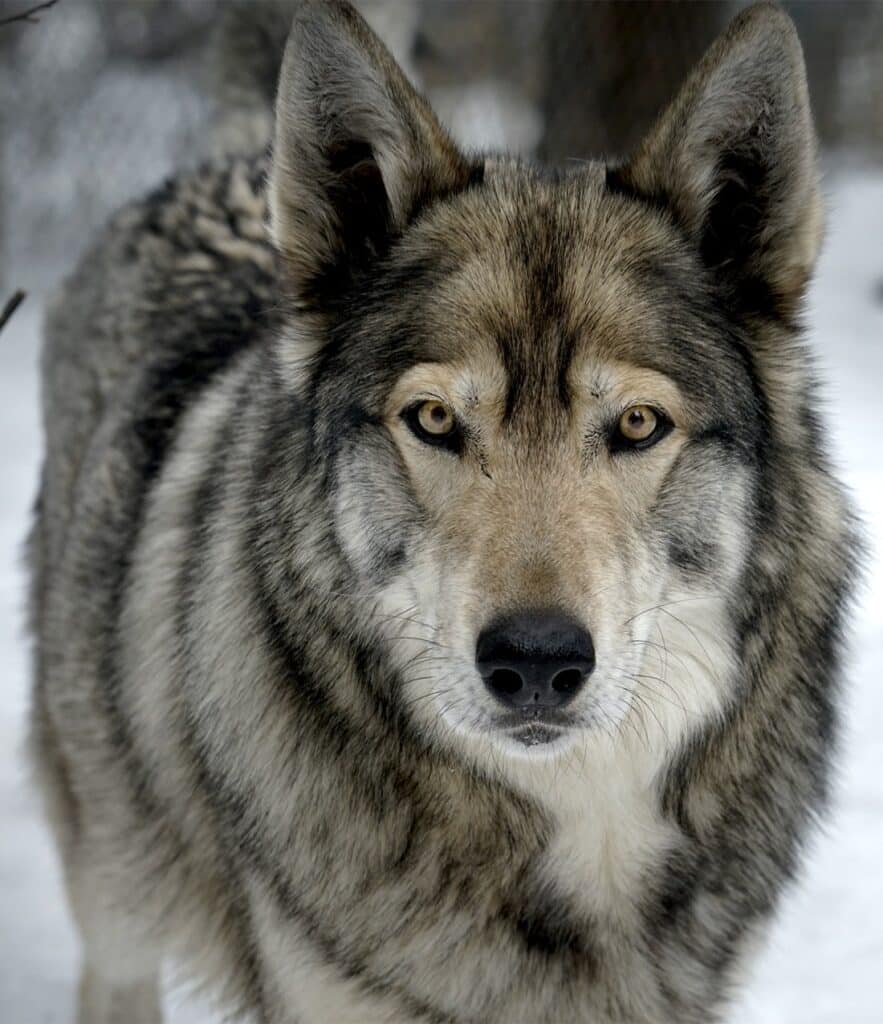
Wolfdogs — animals bred from domestic dogs and wolves — continue to attract attention across Europe and beyond, often surrounded by myths of loyalty, strength, and wild beauty. Yet behind the imagery lies a far more complex reality, one that raises serious questions about behaviour, welfare, legality, and suitability as companion animals.
Despite growing awareness, wolfdogs remain one of the most misunderstood and poorly matched animals in the modern pet landscape.
What Is a Wolfdog?
A wolfdog is a hybrid animal resulting from the crossing of a domestic dog with a wolf. The degree of wolf content can vary widely, from low-content crosses several generations removed from wolves, to high-content animals with recent wolf ancestry.
This variation matters. There is no single “wolfdog temperament.” Behaviour is influenced by genetics, early development, environment, and management — but wolf inheritance introduces traits that differ fundamentally from those of fully domesticated dogs.
Domestication Matters
Dogs have undergone thousands of years of selective breeding for cooperation with humans. Wolves have not.
Wolfdogs often retain behavioural traits that are not compatible with typical pet ownership, including:
heightened flight responses
extreme sensitivity to environmental change
reduced tolerance for confinement
difficulty coping with routine handling
strong seasonal and territorial behaviours
Unlike dogs, wolves and wolf-hybrids are not naturally inclined to seek human guidance under stress. This distinction alone creates significant challenges in domestic settings.
Behavioural Challenges in Home Environments
In practice, many wolfdogs struggle in everyday pet environments. Commonly reported issues include:
escape behaviours and roaming
destructive responses to confinement
fear-based reactivity rather than overt aggression
difficulty with recall and impulse control
stress behaviours in busy or unpredictable households
These behaviours are often misunderstood as “bad training” or “dominance,” when in reality they reflect mismatched genetics in an unsuitable environment.
Legal and Welfare Implications in Ireland and Europe
Across Europe, wolfdogs occupy a legal grey area. Some countries restrict or prohibit ownership outright. Others allow ownership under strict licensing conditions. In Ireland, wolfdogs are not explicitly banned, but they raise serious practical and legal concerns around containment, liability, insurance, and animal welfare compliance.
Because wolfdogs are neither fully wild nor fully domestic, they often fall between regulatory frameworks — leaving owners uncertain and animals vulnerable.
Rescue organisations across Europe report that wolfdogs are frequently surrendered or seized, often when owners realise the animal is unmanageable, escapes repeatedly, or becomes legally problematic.
The Rescue Reality
Wolfdog rescues face unique challenges:
limited rehoming options
specialised containment requirements
difficulty placing animals in domestic homes
long-term sanctuary care becoming the only option
Unlike domestic dogs, many wolfdogs cannot be safely rehomed multiple times without significant welfare compromise.
Aesthetic Demand vs Biological Reality
The continued popularity of wolfdogs is driven largely by appearance — the visual appeal of a “wild-looking” animal. However, appearance does not equate to suitability.
Breeding or acquiring wolfdogs for novelty, status, or image ignores a fundamental truth: wolves were never bred to live as pets, and partial domestication does not reliably change that fact.
Why This Remains a Welfare Issue
Wolfdogs are not inherently dangerous animals — but they are often placed in environments they are not equipped to cope with. When expectations are based on myth rather than biology, the outcome is predictable: stress, surrender, seizure, or lifelong confinement.
This is not a failure of the animal.
It is a failure of human decision-making and responsibility.
An Ongoing European Conversation
As discussions around dog welfare, breeding regulation, and ownership standards continue across Europe, wolfdogs represent a clear example of why genetics, domestication, and purpose cannot be ignored.
Education, not fascination, must drive these conversations.