
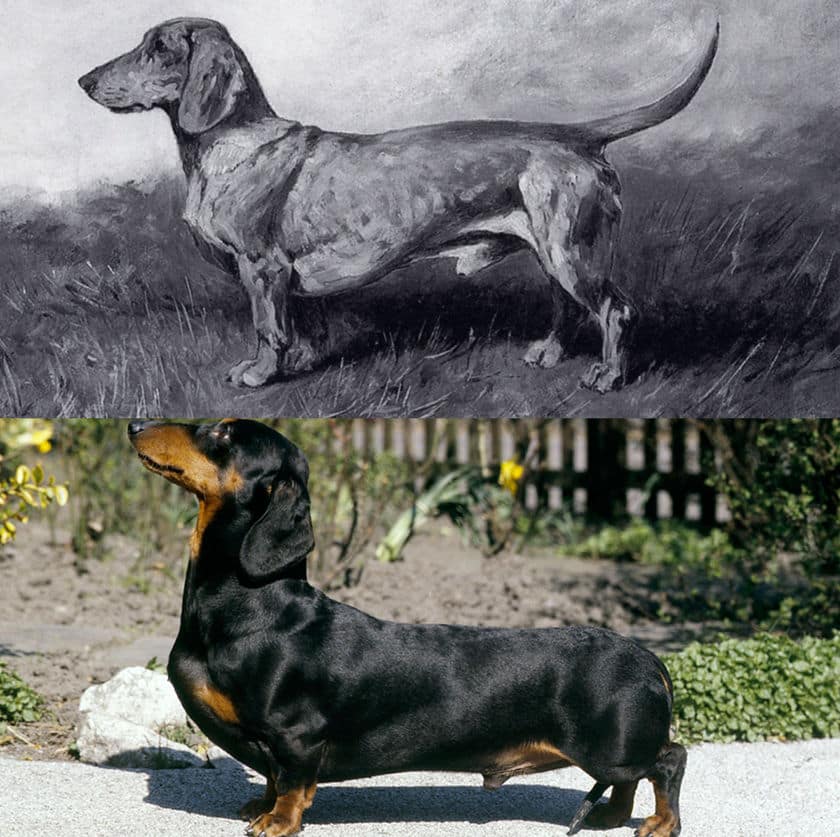
The Dachshund is one of the most recognisable dogs in the modern pet world — small, confident, expressive, and often underestimated. But behind the familiar outline sits a working history that explains why many Dachshunds remain highly alert, intense, and instinct-driven even when kept purely as companion dogs.
Understanding the Dachshund properly requires looking beyond appearance and back to purpose.
Where the Dachshund Came From
The Dachshund is a German breed, also known in its country of origin as the Dackel or Teckel. It was developed from hunting hounds known as Bracken, with selective breeding focused on producing a dog capable of working independently in demanding conditions, particularly below ground.
The breed’s name is literal. Dachshund translates directly as “badger dog,” reflecting its original purpose rather than temperament or appearance.
What the Dachshund Was Originally Bred For
From its earliest descriptions, the Dachshund was a hunting dog used both above and below ground. Its primary work involved tracking, flushing, and engaging quarry — including badgers — in confined spaces where escape was limited and pressure was constant.
This work demanded determination, courage, persistence, fast reactions to sound and movement, and a willingness to continue working under stress. Dogs lacking these traits were not suitable for the role and were not bred forward.
How Long the Breed Has Existed
The Dachshund is not a modern invention. Breed standards describe it as being known since the Middle Ages. In practical terms, this means the Dachshund’s instincts were shaped over centuries, not decades.
Modern domestic life has changed, but genetics formed over long periods do not disappear simply because a dog now lives in a house.
Why the Dachshund Looks the Way It Does
The Dachshund’s structure was functional, not decorative. The elongated body, low ground clearance, strong forequarters, and muscular frame allowed the dog to move efficiently through tunnels and uneven terrain.
The breed was originally a healthy, low-to-the-ground working dog — compact, agile, and physically capable. Its confident, sometimes confrontational carriage reflects a dog bred to meet pressure rather than retreat from it.
From Working Dog to Pet – and the Cost of Exaggeration
As the Dachshund transitioned into the pet and show world over the last century, selective breeding in some lines shifted toward exaggerated outlines — longer backs, shorter legs, and more extreme proportions.
That shift has had consequences. The Dachshund is now strongly associated with intervertebral disc disease (IVDD), a serious spinal condition that can cause pain, mobility loss, paralysis, and long-term management issues. IVDD is recognised as one of the most significant health challenges affecting the breed and has led to dedicated screening and research programmes aimed at reducing risk.
The issue is not the Dachshund’s original design. It is what happens when function and moderation are replaced by exaggeration. When appearance becomes the priority over structural balance, long-term health is compromised — and owners are left managing the outcome.
From Field Dog to Kennel Clubs
Formal breed organisation followed the Dachshund’s growing popularity. The oldest Dachshund breed club, the Deutsche Teckelklub, was founded in 1888, reflecting how established the breed already was in Germany.
International recognition followed quickly. By the late nineteenth century, the Dachshund had spread beyond Europe and entered kennel club systems worldwide.
Standard and Miniature – Size Changed, Instincts Did Not
A common modern misconception is that miniature Dachshunds are behaviourally different from standard Dachshunds. They are not.
Miniature Dachshunds were developed to hunt smaller quarry, such as rabbits. Reducing size did not remove prey drive, independence, or intensity — it simply changed scale. This is why miniature Dachshunds often present as fast, vocal, reactive, and highly driven in everyday life.
Why Dachshunds Still Carry Strong Working Traits Today
In modern homes, Dachshunds are often chosen for size and personality. However, their working traits remain. These commonly show up as:
High prey drive and fixation on movement
Environmental reactivity to sound, doors, and windows
Hyper-alert behaviour indoors
Low frustration tolerance when restrained or blocked
Persistence and resistance to pressure
These traits are frequently described as stubbornness or boldness. In reality, they are expressions of a dog bred to work independently, make fast decisions, and persist under pressure.
Popularity and Misunderstood Behaviour
The Dachshund’s popularity is understandable. It is expressive, engaging, and deeply bonded to its people. But popularity can distort expectations.
When dogs are selected for appearance without regard for purpose, normal breed behaviour is often mislabelled as a problem.
This is not a warning against Dachshunds. It is a reminder that even small dogs can carry powerful working genetics — and that history still matters.
The Canine Report
by Philip Alain